

AI Adoption Framework for your product team
AI has triggered a lot of events and occurrences. And with rapidly shifting economic and social context, it's important for your team to stay ahead.
Content
Context
The Big Question
The Key Strategy
Closing thoughts
Dear Builder,
As I seek out ways to integrate AI more into my workflow, I am reminded that though many people are fascinated by the idea of AI, most don’t yet have the right framework or mental model to approach AI adoption.
So, in order to make this issue more useful, I want to give you a simple reasoning for why staying up to date is not optional anymore and how you can actually navigate it.
The Context
I’m sure by now we all know AI is not a trend. It is quietly redefining what it means to be competent.
A 2025 study found that jobs with “AI-complementary” skills, such as critical thinking and creativity, are growing in demand, while those that rely on repetitive tasks are shrinking.
A key takeway from this is the clearly statement that:
Automation AI affects low-skill, routine jobs.
Augmentation AI increases productivity and pay for professionals who learn how to work with it.
The real story here is that AI is not taking our jobs. It is taking the parts of our jobs that never needed to be human in the first place.
I needed to reinforce this again before we get into the context of what I’m sharing today.
If you would like to stay up to date on how you can leverage AI in building products and companies of the future, this is the place to be.
The Real Question
How do you stay relevant when intelligence itself has become accessible to everyone through a model?
There’s still the part of execution to consider but realistically speaking, AI has made access to knowledge incredibly easy.
1. Learn How to Learn (Forever)
This might feel scary but it very doable and can be fun once it becomes a habit.
AI will change what you know faster than school or 1-year long certifications ever can.
But the skill that never gets outdated is learning itself (especially self-learning).
Researchers call it Continuous adaptability. Micro-credentials, short online courses, and project-based learning (my favourte) are becoming the new degrees.
Action:
Treat your skillset like software. Update it quarterly.
2. Sharpen What Makes You Human
There’s the temptation to lean more into being technical (Hard Skills) in this day and age due to the availability of information but I recommend you fight just as hard for the balance (Soft skills).
Soft skills are now hard currency.
Creativity, judgment, empathy, storytelling, and emotional intelligence remain difficult for AI to replicate. AI complements, but does not substitute, social and ethical intelligence.”
Action:
Pick one human skill you’ve neglected and practice it for the next 90 days. You might need to go out more, interact with other people more, it’s important now more than ever.
3. Become AI-Fluent, Not AI-Phobic
You don’t need to build AI, but you do need to understand it.
The most valuable professionals will be AI-augmented humans, people who see opportunity where others see threat. And the only way to do that is by getting your hands dirty.
Action:
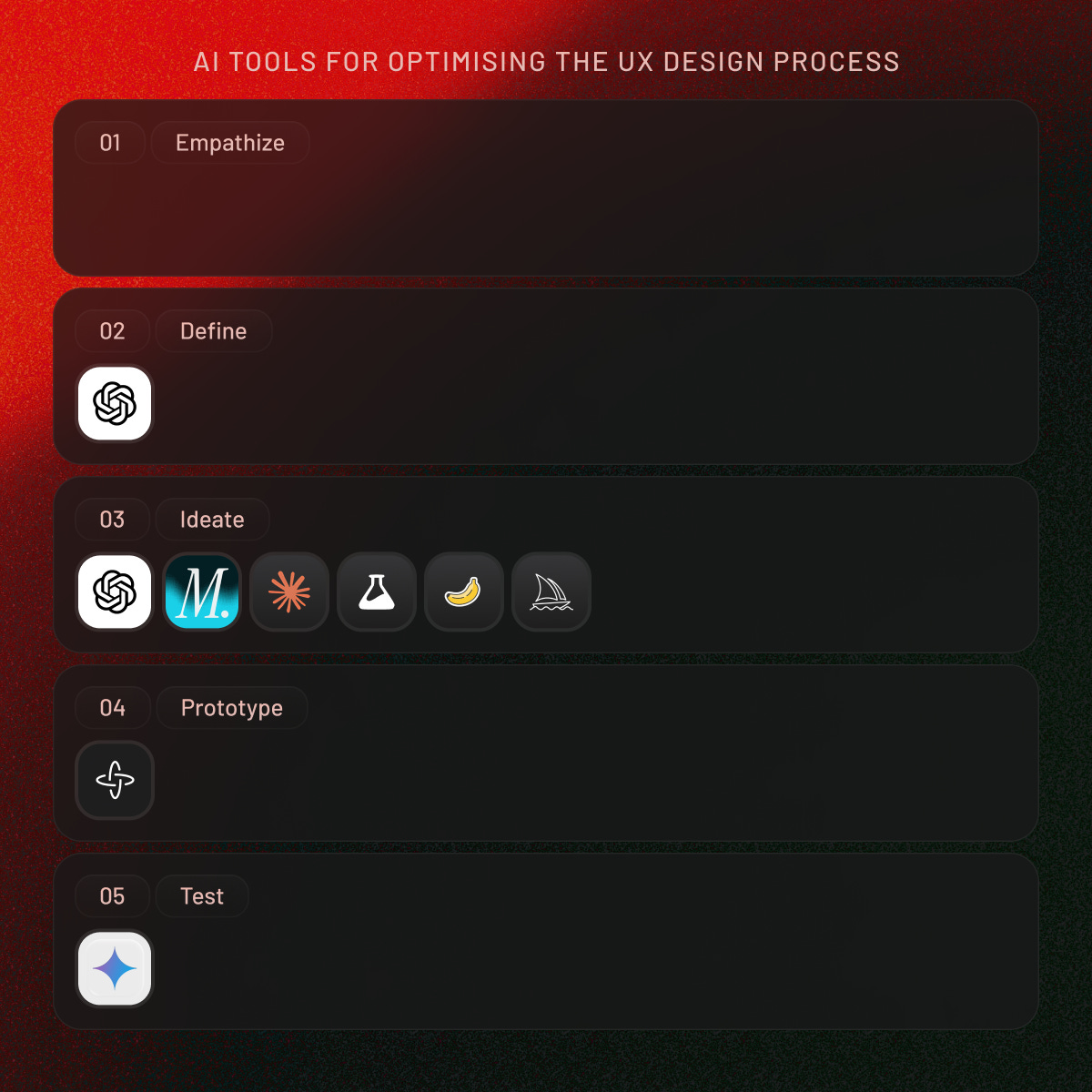
Learn one AI or digital tool that applies directly to your field and use it in a real project. You can reference my UX Process optimisation with IT stack below.
4. Think in Cross-Functional Layers
AI is collapsing silos.
Designers are learning business.
Marketers are learning data analytics.
Writers are learning code.
Professionals who can move laterally will thrive over those defending one shrinking area of expertise. This part has always been easy for me but now, I’m doubling down.
Action:
Once every six months, explore a neighboring skill.
If you’re in marketing, learn data analytics. If you’re in product, study storytelling. If you’re in design, learn to code.
5. Craft Your Visibility
AI may level the playing field, but visibility is still your edge.
Your network, personal brand, and consistent presence online are now part of career survival. Beyond showing up online, also make sure you show up physically.
Action:
Share one meaningful insight or project online as often as you can. Not to go viral, but to stay visible to people who build with you.
Don’t make engagement a priority, just focus on staying consistent.
6. Redefine Your Career as a Living System
Careers are no longer linear. They evolve like products.
Every few years, you will need to refactor what you know and rebuild what is relevant.
Ask yourself:
“What part of my job could AI do tomorrow?”
“What part of my work would still need me?”
Those answers point to where you should focus next.
7. Protect Your Human Energy
Relevance is not just about skill, it is about stamina.
Adaptability, curiosity, and calm under uncertainty are emotional assets now. This is the central theme for this article. Make sure you are, at every point in time, heading towards a change that sodifies your position as a talent in an AI world. Beyond that, remember to be human.
Action:
Build resilience into your workflow. Journal, mentor, learn in public, stay curious. The work will keep changing, and so will you.
Closing thoughts
For any product team to remain relevant and function, the individuals in it have to run the race personally.
AI is not your competition, it is your collaborator.
To make that true, you have to shift your identity from “job title” to “problem solver.”
Those who thrive will be the ones who learn faster than they fear, build stronger relationships than their roles, and create value that technology alone cannot.
Cheers.
Board Update
No update today.

Stay Connected
🐦 Follow me on Twitter/X for daily AI + design experiments